UAV Autonomy Simulation Environment
UAVarta’s simulation platform accelerates the training and validation of UAV flight control software for precision piloting and target engagement. By integrating accurate aerodynamics with configurable mission environments, the platform provides autonomous algorithms with a realistic, repeatable testing environment. This enables developers to optimize control precision, tracking accuracy, and split-second decision-making while eliminating the costs, safety risks, and logistical burdens of live flight testing.
Project Rundown
UAVarta’s simulation platform provides a high-fidelity augmented virtual environment (AVE) dedicated to developing, testing, and validating autonomous flight control algorithms. By replicating the complex operational challenges of piloting small fixed-wing UAVs in combat scenarios, the platform allows control models to learn and evolve under conditions that closely mirror real-world mission environments. Advanced physics and aerodynamic modeling ensure that simulated training translates seamlessly to actual flight performance.
Optimized to run on standard computing hardware without sacrificing professional-grade fidelity, the platform enables algorithm-scale iteration. Developers can train numerous model instances in parallel, achieving a throughput and training volume that physical flight test programs cannot match.
Furthermore, UAVarta’s simulator integrates directly into human-in-the-loop pilot training pipelines. Through augmented reality (AR), operators can fly the exact missions, terrains, and threat scenarios used to evaluate autonomous models. This shared ecosystem keeps algorithm development and human pilot training perfectly aligned – validated against identical physics engines, threat libraries, and operational conditions – while providing engineers with a direct mechanism to benchmark model performance against experienced aviators.







Training Capabilities
- World & Physics – Real-time aerodynamics, weather, wind, turbulence, and day/night cycles, calibrated to small fixed-wing UAV behavior and rendered in photorealistic 3D via AirSim (Unreal Engine) and JSBSim
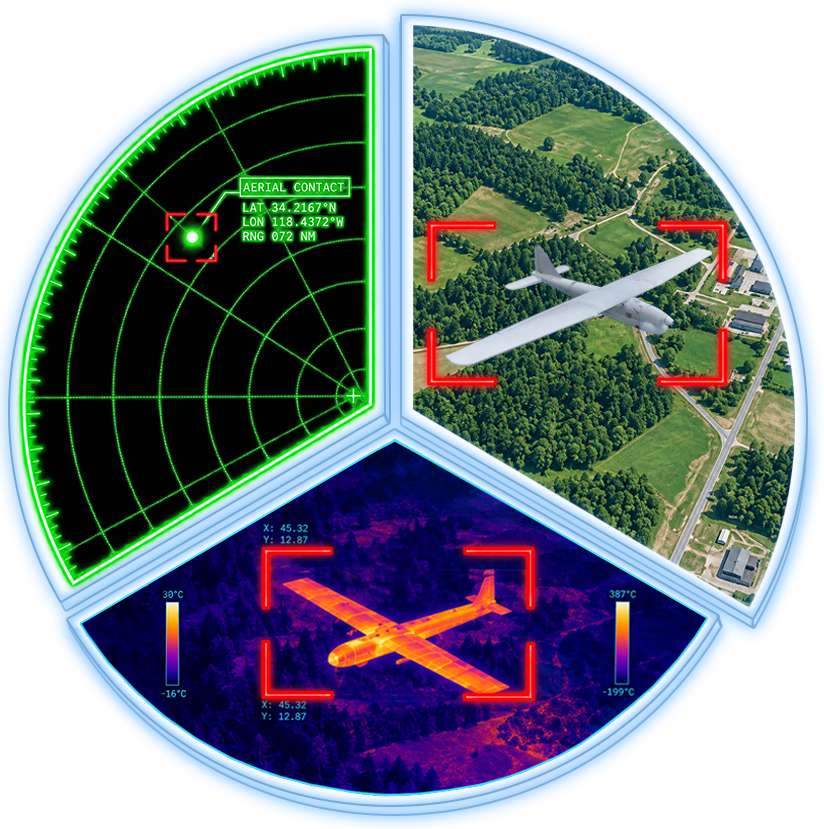
- Sensor Simulation – Daylight, thermal/LWIR, and radar-cueing inputs with configurable resolution and noise, tuned for vision-based model training
- Targets & Environment – Configurable UAV models, real-world terrain, and GNSS-denied, jammed, or electronic-warfare conditions
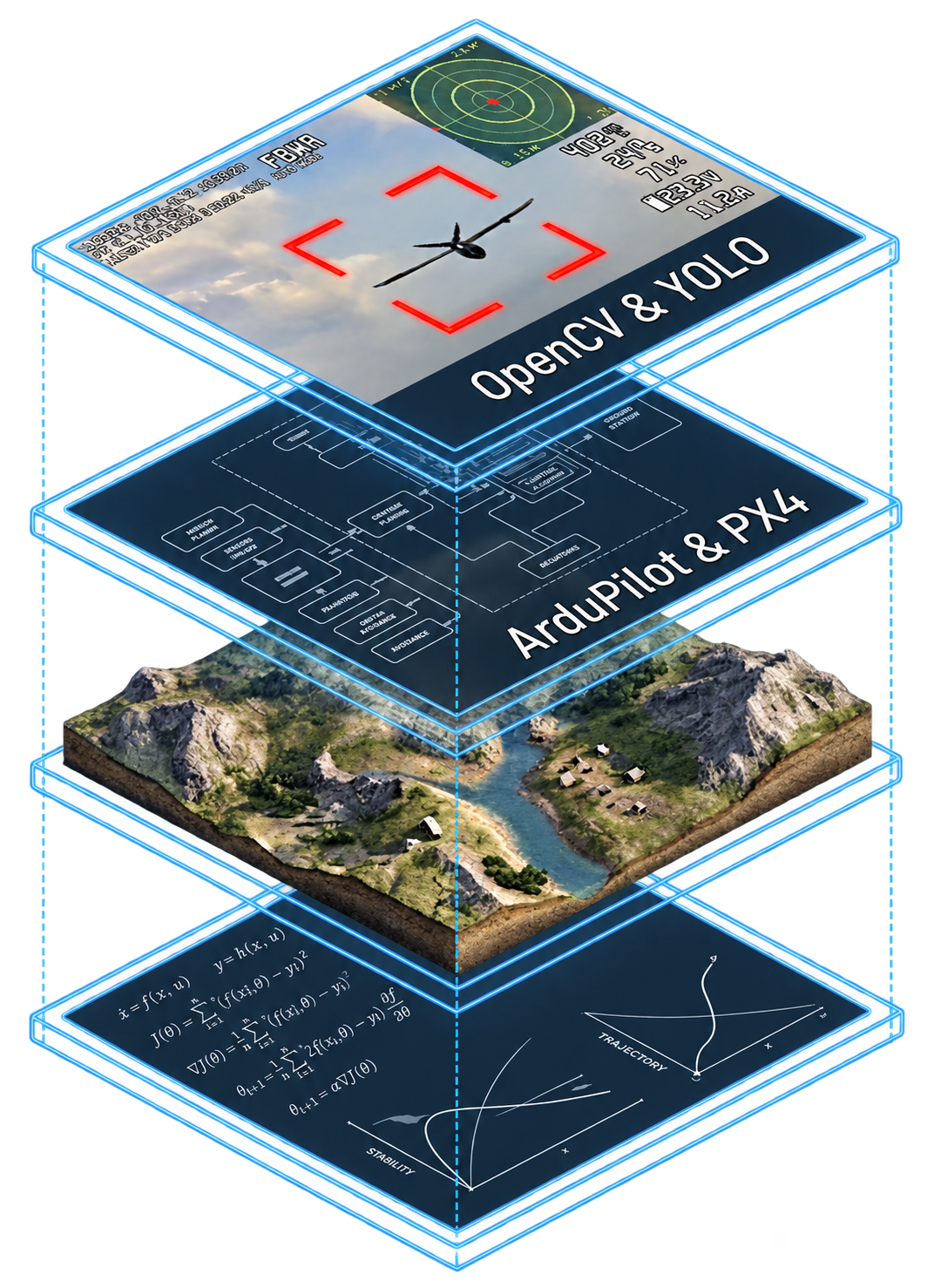
- Autopilot-in-the-Loop – ArduPilot and PX4 Software-In-The-Loop (SITL) support over MAVLink, letting control models run against the same autopilot firmware used in deployed hardware
- Scenario Progression – Difficulty scales from basic maneuvering drills to complex multi-target interception
- Performance Analytics – Debriefing tools track latency, accuracy, engagement success, and flight-path efficiency for quantitative comparison across model versions
Technical Specifications
- Platform: High-performance PC-based simulation (Windows/Linux compatible)
- Simulation Engine: AirSim (Unreal Engine) with JSBSim flight dynamics
- Autopilot Integration: ArduPilot & PX4 SITL via MAVLink and Mission Planner
- Computer Vision Stack: OpenCV and YOLO-based detection and tracking
- UAV Model Library: Extensive collection of real-world drone models for diverse simulation scenarios
- Control Interface: Compatible with real UAV ground control stations, autonomous control stacks, and professional joysticks for human-in-the-loop evaluation
- Recording & Playback: Full mission recording for after-action review and model debugging
- Scalability: Supports single-instance to large-scale, networked, parallelized training runs
Synthetic Datasets
UAVarta’s simulation platform includes a powerful Synthetic Data Generation engine that provides millions of high-quality, precisely labeled training samples. By combining real-world terrain data, detailed 3D target models, and dynamic mission scenarios, the system generates datasets far more diverse than anything collectible from live flights alone.
Key Benefits:
- Massive scalable training data
- Faster model development and iteration cycles
- Highly diverse scenarios (weather, jamming, terrain, threat behavior)
- Automatic labeling of detection, tracking, and interception data
- Continuous improvement of autonomous capabilities

Zero-Risk Model Development
Our simulation platform delivers end-to-end interception training – from initial detection and pursuit to final engagement – without risking valuable hardware or requiring physical target drones. It serves as an essential complement to live testing, letting control policies be trained and validated in a safe, repeatable environment before transitioning to real-world flight.
The result: lower development costs and dramatically higher model readiness and reliability ahead of high-stakes deployment. Fully GNSS-denied ready and independent of live UAV hardware, the UAVarta’s simulator is deployable anywhere for continuous, large-scale algorithm training.